AI is starting to out-design chip engineers in narrow areas as LLMs accelerate software chip design tool development — "There is still a lot of human guidance" says Berkley researcher
We interview researchers and chip design experts to explore where and how AI is being used during the process, and what trials and tribulations come alongside the usage of the nascent technology in their workflows.
AI is starting to out-design chip engineers in narrow areas as LLMs accelerate software chip design tool development — "There is still a lot of human guidance" says Berkley researcher | Tom's Hardware
Skip to main content
Stay On the Cutting Edge: Get the Tom's Hardware Newsletter Get Tom's Hardware's best news and in-depth reviews, straight to your inbox.
Contact me with news and offers from other Future brands
Receive email from us on behalf of our trusted partners or sponsors
By submitting your information you agree to the Terms & Conditions and Privacy Policy and are aged 16 or over.
You are now subscribed Your newsletter sign-up was successful
An account already exists for this email address, please log in.
(Image credit: Getty Images / Ettiene Laurent)
Share
Copy link
X
Share this article
Join the conversation
Follow us
Add us as a preferred source on Google
Newsletter
Subscribe to our newsletter
For decades, semiconductor design has been driven by humans coming up with bright ideas that unlock new innovations. But the benefits of better chip design have been reaped, including the rise of AI, which now means there could be another party involved in making chip designs smarter: AI itself.‘Chip designer’ isn’t one of the roles on the chopping block as AI automation upends the job market. But in the narrow pockets of the design flow where problems are structured, and evaluators are robust, it is starting to be adopted — with benefits.Google DeepMind's AlphaChip reinforcement-learning system has produced designs for three generations of the company's Tensor Processing Units (TPUs), with DeepMind claiming "superhuman" layouts compared with those produced by human designers. They’re not alone: Synopsys has passed 100 production tape-outs with its DSO.ai design-space-optimization tool, reporting productivity boosts of more than three times and power reductions of up to 25% for customers including STMicroelectronics and SK hynix.Latest Videos From"Like every new technology, AI may have multiple uses," said Borivoje Nikolić, professor of electrical engineering and computer sciences at the University of California, Berkeley, in an interview with Tom’s Hardware Premium. Nikolić drew a parallel with Moore's Law, which has historically been exploited in two ways: to reduce the cost of an existing product by porting it to cheaper processes, or to add features that were previously impossible. "I think AI will be used in both ways," he says. "At the moment, the industry seems to be focused on the first item — how to make things cheaper, how to automate things in a better way than they were in the past."
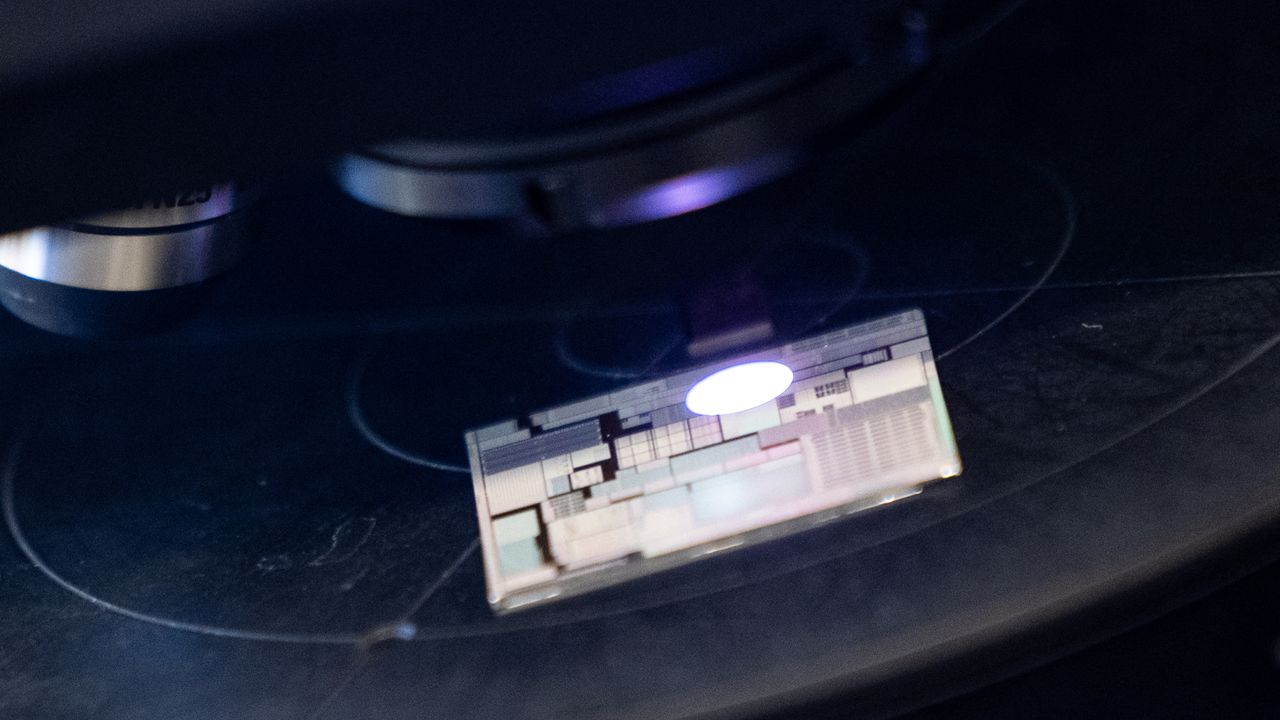
(Image credit: Bella Ciervo, Penn Engineering)By contrast, academics are more interested in using AI to discover things humans haven't yet thought of, an approach that mirrors breakthroughs in areas such as drug discovery and protein folding with the likes of AlphaFold.Nikolić and his colleague Sagar Karandikar have been exploring that territory in their own research on cache replacement policies, a subject deep in the weeds of processor microarchitecture. Their ArchAgent system, built on Google DeepMind's AlphaEvolve framework, generated a cache replacement policy in two days that beat the prior state-of-the-art by 5.3% in IPC speedup on Google's multi-core workload traces. On the heavily worked-over single-core SPEC06 benchmarks, it took 18 days to eke out another 0.9%. That’s a "first sign of life" for Karandikar that large language models can design genuinely new logic, rather than just tinkering with existing parameters."There is still a lot of human guidance, and it kind of up-levels the kind of thinking humans have to do," said Karandikar, a computer architecture researcher at Berkeley, in an interview with Tom’s Hardware Premium. "The humans involved in that project are doing more of the high-level thinking — coming up with new ideas and guiding the LLM — and the LLM does a lot of the finer policy development around that."Where AI is making breakthroughs
(Image credit: Nvidia)For Igor Markov, a chip design researcher who has spent years at the frontline of electronic design automation, the places where AI is adding real value are specific and often mundane. Some of the biggest wins, he says, come at the low end of the flow, such as tasks that previously required engineers to interpret informal specifications written in natural language and convert them into formal descriptions that a tool can act on.Take power and ground networks, the intricate webs of metal that feed electricity across a chip. "They’re sometimes designed just with descriptions in natural language," Markov said in an interview with Tom’s Hardware Premium. "People explain the geometry, and then it's implemented, and at some point, you need to formalize it. This is a step that was done manually, and it's pretty straightforward to automate using AI." The productivity dividend isn’t massive; “it took a couple of days, now it's a couple of hours,” he explained. But is still better than nothing, even if the output still needs to be checked.Where Markov is most bullish is on what he calls the agentic space: the high-level orchestration of chip design flows, including deciding whether a run is doomed or whether a flow needs to be restarted entirely. “If you take a zero multiplied by something, you get a zero,” he said. “But if you already have something decent, then this high-level control can be very, very enabling.”The most stubborn corners of the industry are starting to think about adopting AI. Analog design has long been seen as the last redoubt of human craft, but researchers have begun producing generative AI systems such as AnalogGenie, which uses a GPT-style model to discover new circuit topologies, and Princeton's AI-enabled design-space discovery for millimeter-wave and sub-terahertz power amplifiers operating between 30 and 120 GHz.It’s in these areas that what’s often seen as AI’s failing, that it doesn’t have an inherent knowledge or muscle memory of its own, becomes a strength. Humans have a tendency when porting a design from one process node to another to assume the old topology must be close to optimal for the new one. “AI may not have those kinds of barriers,” said Nikolić.Testing versus real lifeHowever, some caution is needed. AI can be trained to ace demos, but can flunk the messier problems engineers face in practice. "Whether something that works in five cases works in general, and allows you to innovate, that's the key," says Markov.There is also the problem of what it is you are asking AI to do in the first place. Ask a model to design the best chip for AI, and without a formal, unambiguous specification of what best means, the model will produce something — or anything. "You will play whack-a-mole," Markov said when it comes to making it work in practice.He added that every previous jump in design automation has provoked similar debates about whether machines can really think. Shortest-path algorithms for wire routing, once seen as a distinctly human capability, became undergraduate coursework. Placement algorithms now routinely outperform human designers. Logic synthesis, once considered too abstract to automate, is handled by for loops and conditionals. “EDA has always been a type of AI, because it automated what people did,” Markov said. “We are just moving along the straight line, and there's no stopping.”For now, AI is acting as a force multiplier, Markov said, squeezing more output from teams rather than shrinking them. Who’s in those teams and what they bring is also shifting: engineers who are fluent with AI coding assistants are now in demand where they weren't six months ago.Jevons’ paradox also looms large over the potential of AI in the chip design process. As AI makes certain parts of the process dramatically cheaper and faster, Nikolić expects engineers to use that freed-up capacity to explore territory they wouldn't otherwise have dared tackle, including the design of the AI chips driving the whole cycle in the first place.After all, if any class of silicon is ripe for the kind of optimization that hasn't yet been systematically studied, Markov argues, it is the highly structured, performance-critical accelerators powering the current boom. “There’s plenty of opportunity for humans to be improving other parts of the design flow to make it more amenable to these AI-based systems,” said Karandikar. As models become more advanced, so too might their capacities to assist in chip design and development.
TOPICS
Chris Stokel-WalkerFreelance ContributorChris Stokel-Walker is a Tom's Hardware contributor who focuses on the tech sector and its impact on our daily lives— online and offline. He is the author of How AI Ate the World, published in 2024, as well as TikTok Boom, YouTubers, and The History of the Internet in Byte-Sized Chunks.
📰Originally published at tomshardware.com
Staff Writer