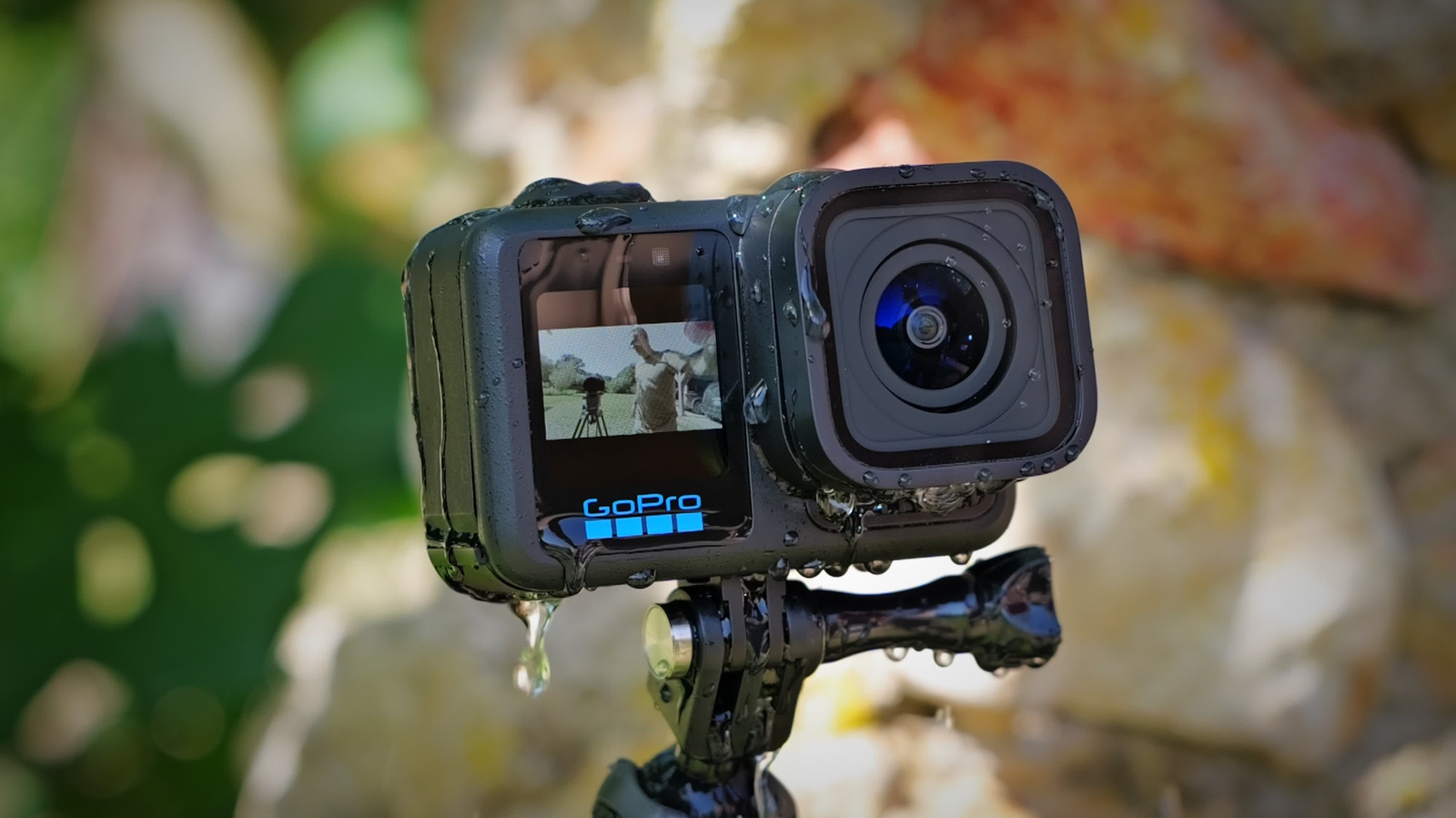
GoPro Mission 1 Pro review: The best action cam video quality comes at a high price
GoPro's Mission 1 Pro action cam has a big 1-inch sensor that offers sharp, color accurate 8K 60 fps and 4K 240 fps video.
GoPro Mission 1 Pro Review: The Best Action Cam Video Quality Comes At A High Price
Reviews
Photography GoPro Mission 1 Pro review: The best action cam video quality comes at a high price It offers 8K 60 fps video and great low-light capability, but it’s more expensive than its rivals. By Steve Dent May 26, 2026 9:10 am EST Steve Dent for Engadget RATING : 8.7 / 10 Pros
Video quality beats all rivals
Good in low light
Excellent battery life
Best stabilization of any action cam Cons
A bit heavy
Expensive With the biggest action camera sensor yet and open gate 8K video, the Mission 1 is GoPro's most important new product in years. The two fixed-lens models — Mission 1 and Mission 1 Pro — promise sharp, color accurate video with excellent dynamic range, along with better low-light performance than other action cams. They're also waterproof, durable and deliver smooth video of extreme action, as you'd expect from a GoPro. However, there are some tradeoffs with a large sensor. The biggest is size and weight as the Mission 1 Pro is thicker and heavier than the GoPro Hero 13. It's also $270 more than that model and its competition. After testing the Mission 1 Pro, though, I believe that the higher quality will easily be worth the extra cash for certain action shooters. The new 1-inch sensor The biggest upgrade with the Mission 1 series is the new 1-inch 50-megapixel sensor that's 13.2 x 8.8mm in size. It's quite a bit wider than the square 1/1.15-inch sensor on DJI's 38MP Osmo Action 6 (though a touch shorter), which means more sensor area for gathering light. The high 50MP resolution allows the Mission 1 Pro to capture 8K video at 60 fps rather than just 4K at 120 fps like the Action 6. Even if you're only releasing footage in 4K, the extra resolution lets you reframe shots or export them at a full resolution for vertical platforms like TikTok. The new sensor also supports 4:3 open gate capture at up to 8K 30 fps (7,680 x 5,760 pixels), again beating all other action cams and many mirrorless ones as well. The Mission 1 Pro's lens is sharp and has a 156 degree field of view that's wider than most action cams. When filming you can choose a 16mm "Superview" that's ultra wide but quite distorted, 16-24mm Wide view that reduces distortion and a 22-27mm Linear mode that eliminates any warping. There are also three models. The Mission 1 Pro model can shoot 8K at up to 60 fps and 4K at 240 fps, while the Mission 1 is limited to 8K 30 fps and 4K at 120 fps — still higher than most rival cams. The Mission 1 Pro ILS model, meanwhile, has a Micro Four Thirds mount for external lenses but no built-in lens. It's designed for professional use where a small camera and high video quality is required, and is arriving later this year. Design and features Steve Dent for Engadget With its larger sensor and lens, the GoPro Mission 1 Pro weighs 0.46 pounds compared to 0.35 pounds for the GoPro Hero 13. It's also about three quarters of an inch thicker. That may not sound like a lot until you mount it on a helmet or a cap and feel the extra front-loaded weight. I hardly noticed it on my chest or around my neck, though, and the extra size won't matter when attaching it to a bicycle or other vehicle. The record and power buttons are now easier to find when you're bombing down a mountain, and feel better than the DJI Action 6's slightly stiff controls. The menus will be familiar to GoPro Hero 13 users, but GoPro moved all the main camera functions — like bit depth, shutter and Hypersmooth — to one place under the "Image" menu. This allows faster access to frequently-used settings. The Mission 1 has larger displays than any previous GoPro, with a 1.4-inch front LCD and 2.59-inch OLED rear display that's 0.3 inches larger than the Hero 13's screen and almost as big as many compact camera displays. Both are bright and sharp enough for sunny days. The Mission 1 uses the same clever mount as GoPro's Hero 13. You can either attach the camera to accessories using GoPro's magnetic latch for quick changes, or just pull down the two GoPro "fingers." I like this system better than DJI's because it means you can still mount it to a selfie pole, helmet or other peripheral without the magnetic latch. Battery life and thermal limitations are the best on any GoPro camera to date thanks to the new processor and Enduro 2 battery. At 4K 30 fps, I got over three hours of battery life, nearly double the GoPro 13's 102 minutes. Even at a demanding 8K 60 fps, I could shoot for well over an hour before the battery expired. The Enduro 2 cell also charges faster thanks to PD2.0 tech, going from 0 to full in an hour, compared to 100 minutes for the Hero 13. The new cells are compatible with the Hero 13's Enduro batteries and vice-versa. The only thermal limitations are at 8K 60 fps and 4K 240 fps. At those settings GoPro says the camera will run about 35 minutes when stationary without airflow, but I was able to shoot for 46 minutes. I also completed a 70 minute bike ride at 8K 60 fps with no shutdown thanks to the air flow. As for ruggedness, the GoPro Mission 1 Pro is waterproof to 66 feet without a housing and the hydrophobic lens cover does a great job shedding water. It's also highly shock resistant; something I confirmed by dropping it and crashing on a bike without incident. One limitation of the Mission 1 Pro compared to its main rival is the lack of internal storage. Where DJI's Osmo Action 6 has 50GB of high-speed memory, the GoPro only offers microSD storage. That's a big drawback, I think, considering the higher price. Video and audio Steve Dent for Engadget Though you may never release footage in 8K, that resolution allows you to reframe shots for 4K output or vertical video platforms. For example, you can punch in on a subject's face to add emotion to a shot, or publish on both YouTube and TikTok in 4K without compromising quality. It also offers 4K 240 fps and 1080p at 960 fps, incredible super slow-mo that's ideal for action content. In daylight, it delivers more cinematic footage than any action cam I've tested, aided by the larger sensor, sharp lens, new (GP-Log2) 10-bit setting and a high 240Mbps data rate. With all that, I was able to capture footage with accurate, natural colors and soft, filmic grain. The video was easy to adjust in post, letting me reduce highlights and reveal clean shadow detail. The Mission 1 Pro is a bit better in low light than DJI's Action 6 thanks to the larger sensor. Though not great in the dark of night, it shines in dim-light scenarios like a forest at dusk, since you can shoot at higher ISOs and shutter speeds than other action cams. The result is crisp footage with minimal stabilization artifacts. The 8K also helps GoPro's subject tracking, as it keeps subjects sharp when cropping in. However, it occasionally fails to lock onto subjects in low light. Another intelligent capture mode is Dive, which tunes video stabilization and color correction underwater. I tested the Low Light mode that promises high-quality footage in challenging lighting conditions. It did help a little at night, but footage in shadow areas was quite grainy. DJI's HyperSmooth electronic stabilization is still the best of any action cam. In good light, it provides gimbal-like smoothness even with jolting action like mountain biking, skiing, windsurfing, drones or motocross. In dim light, I only saw the occasional motion blur artifact. GoPro also developed the Mission 1 with photography in mind. You can shoot RAW or JPEG at the full 50MP resolution if light is sufficient or dial down to 12MP for extra sensitivity in low light. I captured a number of photos in tricky sunny and night conditions and found it delivered sharp and color accurate results. However, the lens is at least twice as wide as most compact cameras, so you'll need to get close to your subjects. For audio, the GoPro Mission 1 series now has four microphones, including two front-facing stereo mics, a new rear-fac
📰Originally published at engadget.com
Staff Writer