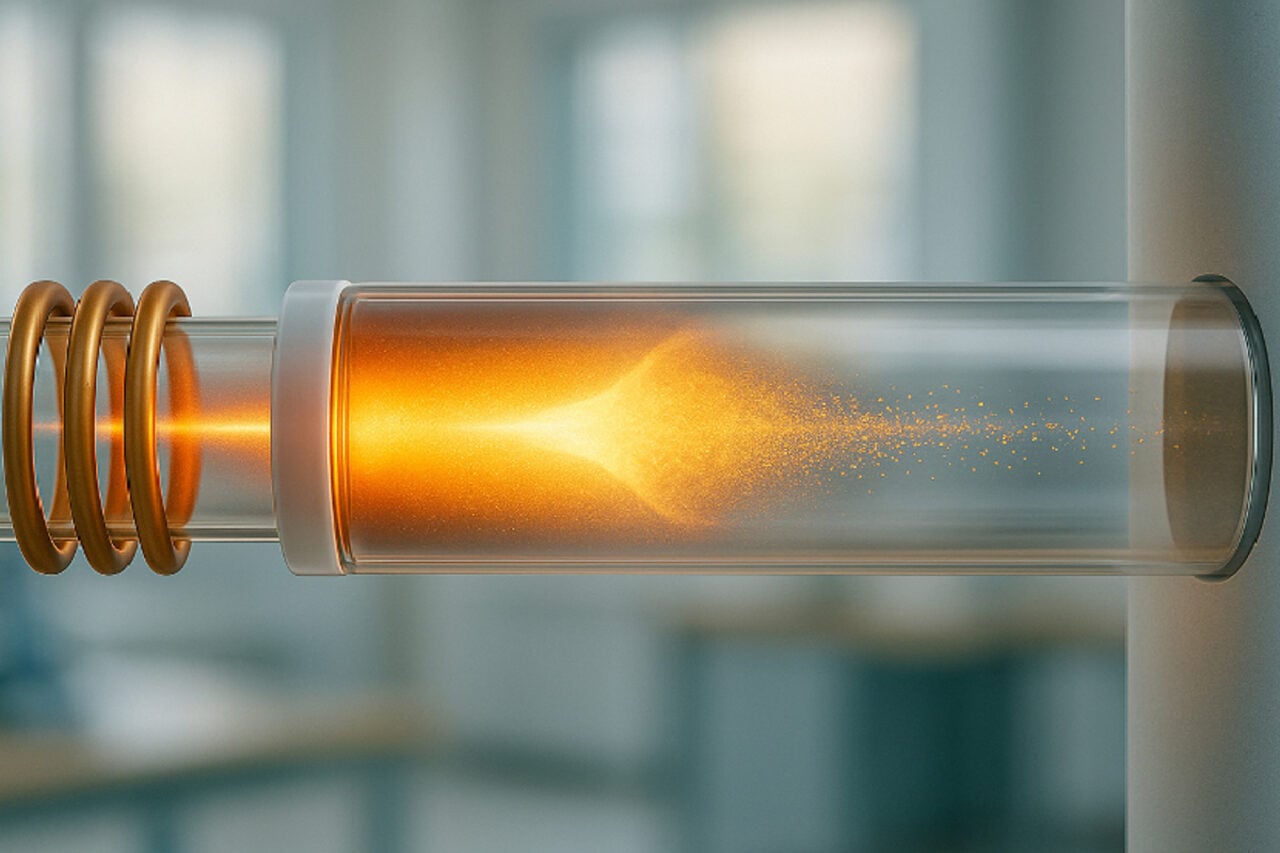
Scientists Create Miniature Fireballs to Study Fallout From Nuclear Accidents
“We can replace assumptions with measurements, improve the models used to interpret nuclear debris, and support decision-making when it matters most.”
Scientists Create Miniature Fireballs to Study Fallout From Nuclear Accidents
Skip to content
Energy Scientists Create Miniature Fireballs to Study Fallout From Nuclear Accidents “We can replace assumptions with measurements, improve the models used to interpret nuclear debris, and support decision-making when it matters most.” By Gayoung Lee
Published May 27, 2026, 7:30 am ET
Reading time 2 minutes
A diagram of the plasma flow reactor that can be used to examine particles as they move from a hot plasma (left) to a cooler condensed state (right). Credit: Lawrence Livermore National Laboratory
Read Later Read Later Comments (0)
In the aftermath of nuclear accidents, radionuclides mix with the debris and soil in their vicinity. When this dangerous mixture “falls back” to us, the resulting nuclear fallout can cause lasting damage. For practical reasons, current fallout models fall short in fully describing these toxic events—but a clever miniature may finally offer scientists a better way to study them. Researchers at Lawrence Livermore National Laboratory (LLNL) created a small replica of the fireballs that trigger nuclear fallout inside a plasma flow reactor. The carefully controlled experiment allowed them to investigate how uranium, cerium, and cesium vaporize and behave. As a result, the team was able to identify limitations in current fallout models under more realistic conditions. They published their findings in a recent Analytical Chemistry paper. “By studying these processes in a controlled system, we can replace assumptions with measurements, improve the models used to interpret nuclear debris, and support decision-making when it matters most,” Rakia Dhaoui, the study’s first author and a scientist at LLNL, said in a statement.
A mini fireball For the experiment, the team customized a plasma flow reactor to freely program different temperatures and oxygen fugacities (i.e., how easily chemicals move and react). The miniature represents a portion of the fireball process, which triggers nuclear fallout by expanding and mixing into air after a nuclear accident, according to LLNL.
Annotated photograph of the modified plasma flow reactor. © Dhaoui et al., 2026 Specifically, fallout is when the fireball begins to cool and condense into tiny solid particles, so the experimental setup was designed to replicate these steps. The researchers set up two scenarios: one imposed a consistent temperature decrease along the tube, whereas the other kept the heat at around 2,060 degrees Fahrenheit (1,127 degrees Celsius) before rapid quenching, according to the study. “Historical fallout studies indicate that the path materials take as they cool is important,” Dhaoui explained. “Cooling rate and time at elevated temperature can alter chemical speciation and particle formation.”
A fork in the fire The lab tests found that the three elements studied all behaved differently. Uranium condensed early on, with cerium condensing in a similar temperature range. Both elements’ chemistry varied depending on the cooling scenarios. On the other hand, cesium took much longer to condense and interacted more with other elements when kept for longer at a higher temperature. “These results suggest that fallout formation depends not only on when elements condense, but also on how elements chemically interact during cooling,” LLNL explained. This is in contrast to existing models that tend to consider each element individually, but these complex interactions are likely “essential” for improving predictive models of processes relevant to nuclear fallout, according to the paper.
Explore more on these topics Nuclear fallout nuclear physics
Share this story
Copied!
Sign up for our newsletters Subscribe and interact with our community, get up to date with our customised Newsletters and much more. Gizmodo io9 Earther The Next Interface Subscribe now Leave this field empty if you're human:
Related Articles Can Smart Glasses Ever Be Privacy-Friendly? These Companies Think So We talked to leaders from several of the biggest Meta competitors, and they're adamant that smart glasses don't have to be a privacy nightmare. Gadgets
James Pero May 21
Dive Into the Elusive World of Particles With the Global Physics Photowalk Finalists This year's winners offer behind-the-scenes access to the frontiers of particle physics research. Physics & Chemistry
Gayoung Lee Feb 13
Scientists Just Took a Giant Step Toward Scaling Up Nuclear Fusion: ‘What We’ve Done Here Is the Start of What Is Still a Long Journey’ Using a combination of physics and machine learning, the researchers predicted how the plasma inside a tokamak reactor would behave given a set of initial conditions. Physics & Chemistry
Gayoung Lee Oct 12 '25
Gizmodo Science Fair: A Greener Way to Fuel Nuclear Fusion An innovative method for trapping lithium ions has led to a promising technology for extracting precious lithium isotopes—a crucial ingredient for fueling nuclear fusion experiments. Science
Gayoung Lee Sep 22 '25
Scientists Built a Beer-Fridge-Sized Reactor That Brings Fusion Closer Called Thunderbird, the pint-sized nuclear reactor is supported by relatively simple electrochemical concepts. Physics & Chemistry
Gayoung Lee Aug 20 '25
Scientists Pitch Bold Plan to Turn Nuclear Waste Into Nuclear Fuel Tapping into discarded nuclear waste could help generate a self-sufficient source of a key ingredient for nuclear fusion, a new plan proposes. Energy
Gayoung Lee Aug 18 '25
Search
Sign up for our newsletters
Latest Tech News Artificial Intelligence
📰Originally published at gizmodo.com
Staff Writer