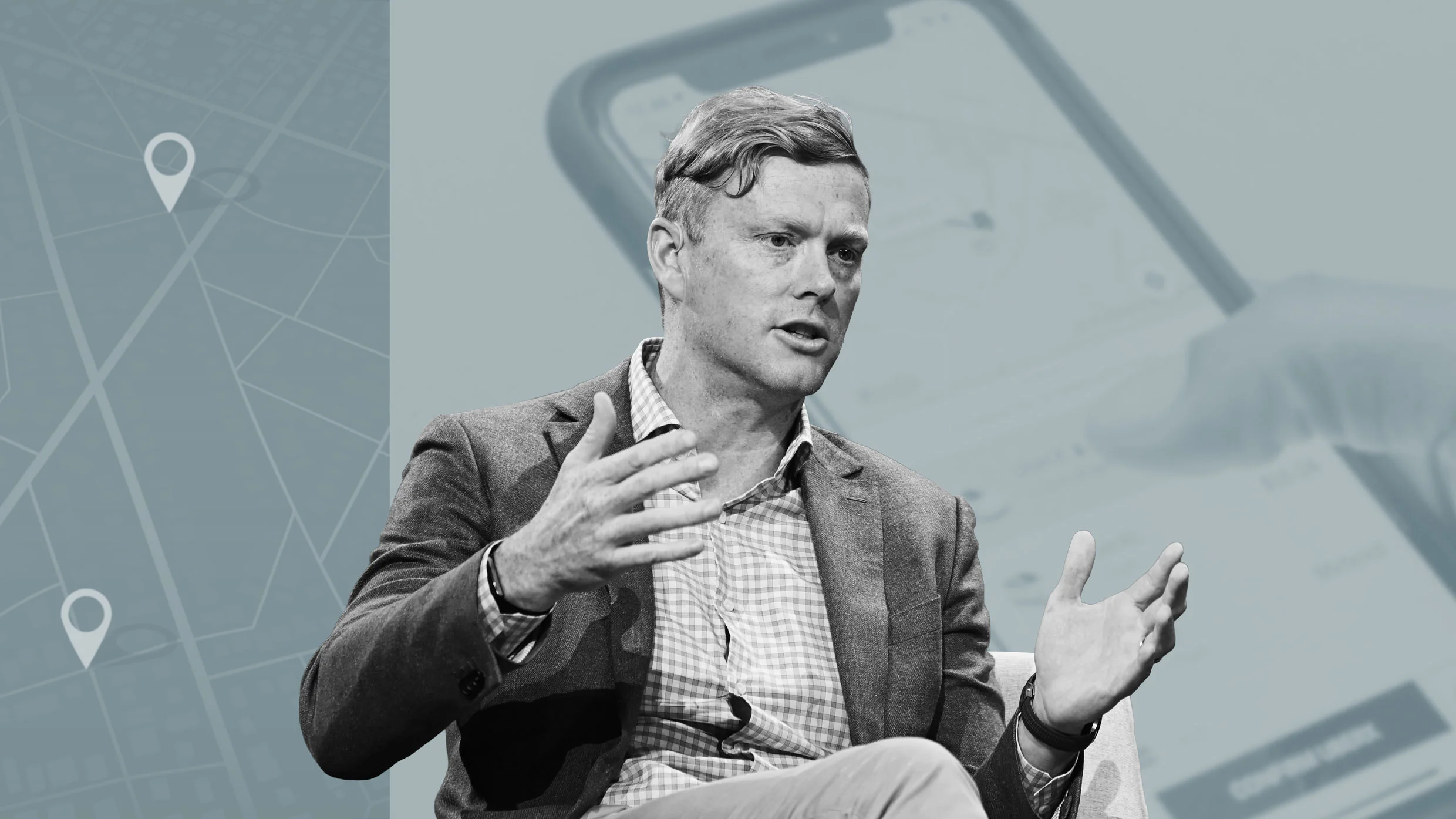
Uber’s Andrew Macdonald on what America’s economy looks like from the driver’s seat
Few companies are a stronger barometer of the American economy today than Uber, and few executives have a clearer view of what’s coming than its president and COO, Andrew Macdonald. He shares what Uber’s real-time data reveals about consumer behavior amid surging gas prices, and...
Uber’s Andrew Macdonald on what America’s economy looks like from the driver’s seat
Few companies are a stronger barometer of the American economy today than Uber, and few executives have a clearer view of what’s coming than its president and COO, Andrew Macdonald. He shares what Uber’s real-time data reveals about consumer behavior amid surging gas prices, and confronts the uncomfortable question at the heart of Uber’s autonomous vehicle push: What does the company actually owe its millions of drivers?
This is an abridged transcript of an interview from Rapid Response, hosted by former Fast Company editor-in-chief Robert Safian. From the team behind the Masters of Scale podcast, Rapid Response features candid conversations with today’s top business leaders navigating real-time challenges. Subscribe to Rapid Response wherever you get your podcasts to ensure you never miss an episode.
A lot of the news right now is about rising gas prices and the Strait of Hormuz being choked off, putting pressure on everyone who drives. What are you hearing from your drivers? And what can you do to help? Raise rates for riders? How do you navigate that piece of this moment?
Yeah, so that’s something we obviously focus on a lot. We think about the people that earn money on our platform holistically. We think about what their P&L [profits and losses] looks like, not just what our P&L looks like. I think the good news is, even though rising gas prices [are] really tough for people who drive for a living, when you look at the percentage that an increase in gas prices has on—how much of that flows through to—the drivers’ weekly P&L, if you will, [the impact] is actually relatively modest.I’m not saying it’s insignificant. Every dollar matters, but it’s not necessarily the extreme flow through to price that you would see in an airline industry, for example. Now that said, we are responsive to it. Driver sentiment is impacted when gas prices go up. We see it in our data right away. They also want to see a response from the company. In the past, we’ve made some mistakes. Candidly, for instance, we’ve done direct fuel surcharges in the past, where we just put [an] additional [fee]—call it a buck—on the consumer receipt.
Charging riders a little more.
Charging riders, but also doing it in a very direct pass-through way. Put it on the receipt, fuel surcharge, here’s the impact. The challenge with that for us is, it’s a bit of a fixed lever. When you pull that back, if gas prices revert to pre-crisis levels, is that your license to pull it back? You’re still going to have folks that are unhappy if you pull it back at that moment. And so we actually try to use levers that are a bit more flexible. In some cases, that means we just take some of the hit—i.e., we take lower margins, lower take rates. In some cases, we actually just raise underlying prices. So instead of having it be a surcharge, if the marketplace is tight, our prices go up. That’s the benefit of a dynamic pricing marketplace like what we’ve got. And in other cases, we’ll actually just try to negotiate on the driver’s behalf. So in the U.S., we’ve rolled out a bunch of fuel discounts through our driver loyalty program that actually end up offsetting most of the cost.
You emphasized the local nature of Uber’s business. I was thinking that you serve both folks who go out for the night and those who stay in and order takeout. And in that way, your business has a barometer of the economy in some ways, of what’s going on on the ground.
We’re constantly looking for what’s coming in our data. So we will slice by zip code, whatever we know socioeconomically about our customer cohorts. We’ll look at the different credit card types, different payment methods, all sorts of different cuts to try to get at: Is the consumer weakening? And we just don’t see it. I think we’re a really good barometer of the labor market, actually a more pure barometer of the labor market, than consumer health. Generally, the barriers to getting on the Uber platform as a worker, compared to other jobs, are quite low.And we tend to be a really good sign of the local labor market. When there is high unemployment—and again, I would not say that at the federal level or even state level; I’d say at a city level or even a zip code level—you see more supply come into the market and prices go down until there’s an equilibrium found between price and earnings. And when labor markets are tight, you see prices go up and, again, that equilibrium gets found at higher prices. So a lot of people study us for labor data, and right now the labor market’s quite healthy in the U.S., in particular. Prices are not necessarily coming down as a result of excess labor supply. And so I think that shows the economy’s still ticking along.
I recently had Zoox’s CEO, Aicha Evans, as a guest on the show, and you’ve partnered with Zoox and also with Waymo. Uber shuttered its own AV [autonomous vehicle] effort several years ago, but you’ve left the door open to reviving it. As you talk about AVs, it sounds like you’re a believer that AV fleets, they’re coming, they’re going to be here. Will you need to have your own AVs in the long run? Can you just be the conduit for others?
It’s a great question and candidly, it’s a question that I think we have a responsibility as a management team to continue to revisit. We have 25 autonomous vehicle partnerships today globally and are starting to work with our partners to scale, helping them build out the physical world infrastructure they need to scale—whether that’s depots or charging capacity, remote vehicle management or customer support. It’s no longer about, hey, let’s just get a couple of vehicles on the road and test that our integration works and help see how your technology performs, but about how do we go from five vehicles to 500 to 5,000? And to me, that’s a matter of when, not if, the technological problems are largely solved. It becomes a business model problem and a scaling problem.And our job is to make sure that the economic return on those assets [is strong] for our partners, or for whoever the ultimate vehicle owner is, right? Because I think many models will emerge. I think you’ll have fleets that will own these assets. I think you’ll have financial investors that will own these assets. I think you’ll have individuals that will own these assets. So whether or not we need to own vehicles directly, own fleets directly, own the technology directly, I think is something that will get answered over time. Our position today is that that’s not our role in the ecosystem. But like any management team, we should always be open to changing our mind. If the facts change or our strategy is proven to be wrong, then we’ll have to change direction.
[Addressing] your current human drivers who are worried about being replaced, like many people are worried about being replaced by AI, what do you feel like your responsibility is in that transition toward those drivers compared to the responsibility of the cities, of the governments?
One of the ways you don’t make this entirely a government problem is that corporations act responsibly. And so when we advocate for things like a hybrid network, when people are requesting an Uber, they may get that fulfilled by an autonomous vehicle. They may get it fulfilled by a human driver. We think a hybrid transition is a very responsible transition. That allows us to continue to grow the pie. Our business is still growing north of 20% a year, and that means that human ride-share jobs and earnings are still growing. And I think they will for years to come, even as we layer in autonomous vehicles to our network, and I think that helps the transition. More than 10 million people earn money on the Uber platform globally, and we have a deep responsibility to those folks to help them have opportunities in the future. We, of course, will work with governments on this transition, but I think corporations need to lead the way.
📰Originally published at fastcompany.com
Staff Writer
Related Articles
Uber and Lyft drivers in Massachusetts certify the nation’s first ride-hailing union
May 26, 2026·5 min read
Why are big AI companies embedding engineers with customers, and what does that mean?
May 26, 2026·9 min read
How this wearable AI technology is helping NBA, NHL and athletes everywhere prevent injuries
May 26, 2026·5 min read